Monday, February 15, 2010

you are not a gadget part 2

Another book I'm reminded of as I'm reading Lanier's manifesto is Vincent J. Miller's Consuming Religion. Assistant Professor of Theology at Georgetown University, Miller observes that when his students need answers to a question, they invariably "google" it as do my students, and if you are a teacher, yours too I'm guessing. They are almost immediately granted random access to the little piece of data that answers the question. The information provided, though, is divorced from any of its rich historical context, instead offering "sound byte" answers in effect. The medium provides the glut of information without filtering the important from the unimportant, the true from the false. That type of sifting requires an informed reader or interpreter.   

Shane Hipps has explored similar ideas in his book The Hidden Power of Electronic Culture. Hipps says that the hidden message given by the ease which we can access contextless information is that the historical context of information is irrelevant, that, in fact, "truth is entirely idiosyncratic".

Digitally stored "information is alienated experience," says Lanier. Yes, it objectively exists, but it is only de-alienated (contextualized?) if it is experienced: "If the bits [of information] can potentially mean something to someone, they can only do so if they are experienced. When that happens, a commonality of culture is enacted between the storer and the retriever of the bits. Experience is the only process that can de-alienate information" (p. 29).

And yet the information itself, even if it's experienced, comes to us in an "alienated" form...without context.

Saturday, February 13, 2010

you are not a gadget

Some of my favorite lines in A Tale of Two Cities are not the famous opening or closing lines...rather the first lines in Chapter 3: 

A wonderful fact to reflect upon, that every human creature is constituted to be that profound secret and mystery to every other. A solemn consideration, when I enter a great city by night, that every one of those darkly clustered houses encloses its own secret; that every room in every one of them encloses its own secret; that every beating heart in the hundreds of thousands of breasts there is, in some of its imaginings, a secret to the heart nearest it!

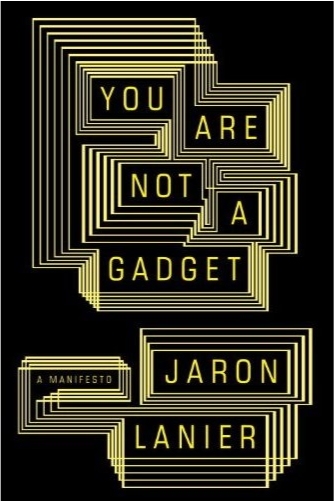
I thought of that passage recently as I was reading Jaron Lanier's You Are Not a Gadget. His book, though certainly a polemic against the mediocre mob mentality Web 2.0 fosters, is also a celebration of the mystery embodied in consciousness, in personhood. His insider perspective (as a Silicon Valley "techie" from the early days of the internet) is definitely provocative. He writes about the design decisions that have become "locked in" -- that have fundamentally changed culture. He says, "the deep meaning of personhood is being reduced by illusions of bits." He lists suggestions to promote intentional individual creativity, "to be a person instead of a source of fragments to be exploited by others." He says:
  • don't post anonymously unless you really might be in danger
  • create a website that expresses something about who you are that won't fit into the template available to you on a social networking site
  • post a video once in a while that took you one hundred times more time to create than it takes to view
  • write a blog post that took weeks of reflection before you heard the inner voice that needed to come out
As long as you are not defined by software, you are helping to broaden the identity of the ideas that will get locked in for future generations. In most arenas of human expression, it's fine for a person to love the medium they are given to work in. Love paint if you are a painter; love a clarinet if you are a musician. Love the English language...Love of these things is a love of mystery. But in the case of digital creative materials...it's a good idea to be skeptical.  (pgs. 21-22)

He tells you why in the rest of the book.  Whether you blog or tweet or text, you should read it, even if just for the unique perspective he offers. And while you're at it, pick up A Tale of Two Cities too.